
The latest QS Global Student Flows: UK report shows that demand from key markets – India, China, Nigeria, Pakistan and the United States – remains structurally strong.
But growth patterns are shifting. Policy changes, affordability pressures, and, increasingly, the graduate labour market are shaping student decision-making. Global competition is also intensifying, with Asian universities gaining ground in global rankings even as the UK resets its international education strategy to sustain its world-class position – a trend we examined in Global Competition is Rising but the UK Remains World Class.
Meanwhile, as we explored in The Graduate Labour Market is Shaping Student Recruitment Decisions, students aren’t disengaging. They’re risk-managing. They are responding to labour market signals, assessing ROI, and scrutinising outcomes more closely than ever.
Demand is holding – but it’s becoming more selective
QS projects South Asia will remain the UK’s strongest growth area, expanding from roughly 245,000 students in 2024 to around 340,000 by 2030.
However, growth from East Asia is expected to be slower, tougher VISA rules are influencing student recruitment, and students are increasingly prioritising employability when deciding where to study.
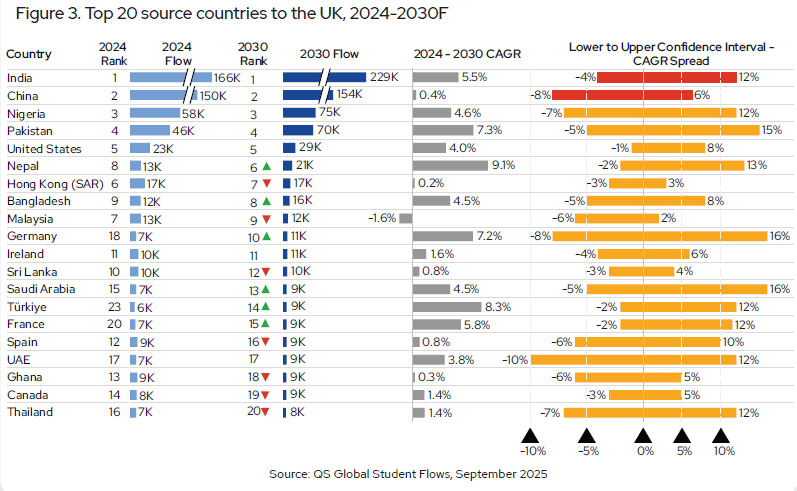
The chart highlights stronger projected growth from South Asia and parts of Africa, contrasted with slower or flat growth from China and parts of East Asia.
Employability is now the decision filter
QS data shows that 50% of UK-bound students say information about work placements and links to industry is useful in their decision-making. Across regions, more than half choose courses because they allow them to develop new skills for their careers. At the same time, QS highlights a tension: employment outcomes performance does not always match employer reputation, suggesting perceived skill gaps. This aligns directly with labour market signals. Graduate hiring has become more competitive, sector-specific, and outcome-focused. Students are therefore responding accordingly.
What Students Value Most When Choosing a University
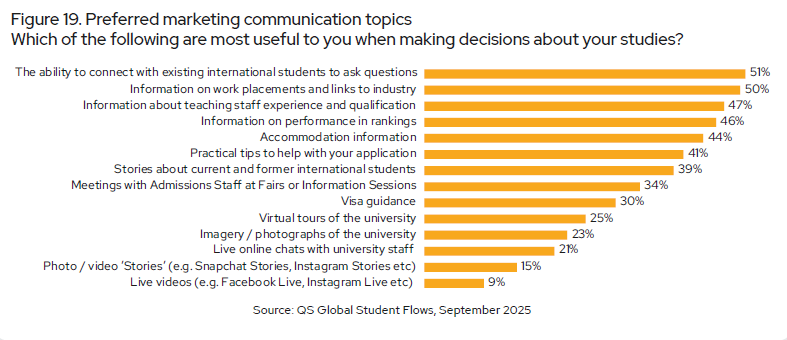
The chart highlights the growing importance of employability, with 50% of students prioritising work placements and industry links.
Three Scenarios for 2030
QS outlines three possible futures. None are fixed. All are strategically relevant.
1. Regulated Regionalism
This scenario assumes tighter migration policy, stricter compliance expectations, and more segmented recruitment strategies.
In such an environment:
-
Visa clarity becomes a competitive advantage
-
Institutions may deprioritise higher-risk markets
-
Students weigh immigration stability alongside employment prospects
When labour market uncertainty combines with policy friction, decision cycles slow. Postgraduate applicants in particular become cautious.
In this future, reassurance and transparency matter as much as reputation.
2. Hybrid Multiversity
Here, blended and offshore delivery expands. Students begin online or locally before transitioning to shorter, industry-focused UK experiences.
This aligns with emerging student psychology:
Reduced financial exposure
-
Faster skills acquisition
-
Clearer industry linkage
As labour markets signal selectivity, hybrid pathways offer flexibility and perceived risk mitigation.
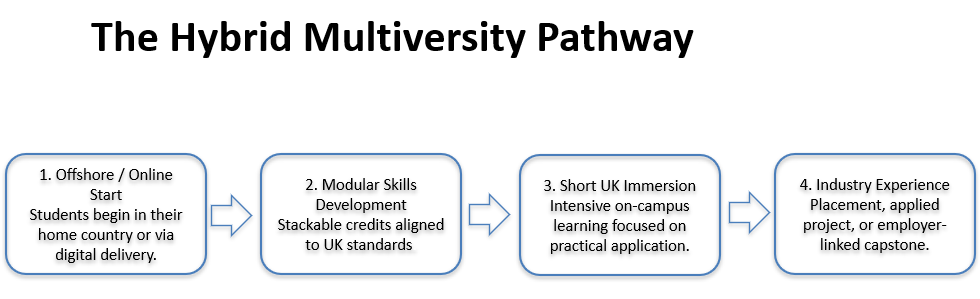 The Hybrid Multiversity scenario outlined by QS describes a blended pathway in which students begin offshore or online before completing shorter, industry-focused periods in the UK. This also aligns with the continued rise of transnational education (TNE), as UK institutions expand offshore partnerships, branch campuses and digital delivery to maintain global presence while managing migration constraints.
3. Talent Race Rebound
This is the most growth-oriented scenario. International education becomes embedded within national skills strategy.
Skills England modelling projects approximately 0.9 million additional roles across priority occupations between 2025 and 2030 – particularly in Digital, Adult Social Care, Construction and Engineering.
In this future:
-
Visa pathways align with priority sectors
-
International graduates are positioned as contributors to workforce demand
-
Universities differentiate via industry alignment
This scenario directly connects recruitment strategy with economic growth.
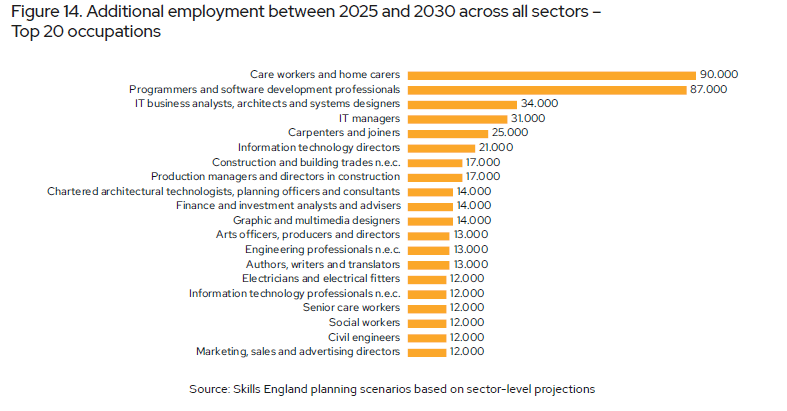
This chart highlights where future labour demand is expected to concentrate, reinforcing the strategic importance of digital, care and construction pathways.
Risk-Aware Students
Across all three scenarios, one behavioural constant remains:
Students are calculating return on investment.
They are asking:
-
Will this degree improve employability?
-
Is migration policy stable?
-
Does the labour market support this subject choice?
Recent graduate recruitment data suggests competition remains high across many sectors. That doesn’t suppress demand. It sharpens expectations.
Students are not withdrawing. They are becoming selective.
Strategic Priorities to 2030
Regardless of which scenario dominates, three priorities stand out:
1. Make employability evident
Beyond rankings, students want evidence – placements, partnerships, outcomes.
2. Align courses to growth sectors
Digital, care, engineering and construction are projected growth areas. Programme development that visibly reflects this strengthens both recruitment and reputation.
3. Communicate stability
In regulated environments, clarity builds confidence. Transparent visa guidance and policy literacy reduce perceived risk.
Final Thought
The UK’s international recruitment story is not one of decline. It is one of redistribution and refinement.
The universities that succeed by 2030 will not simply be those with strong brands.
They will be those who understand:
-
Labour market psychology
-
Policy direction
-
Sector-specific demand
-
And the growing centrality of employability
We’re always happy to discuss what this could mean in practice. For more information, contact kim.mclellan@hunterlodge.co.uk