
Global competition in higher education is intensifying. Asian universities are gaining ground in international subject rankings, while the UK is revising its approach to UK international education strategy to protect and extend its world-class position.
UK strategic reset
As reported in the Financial Times recently, the UK government has unveiled a new International Education Strategy. No longer aiming for a specific number of international students in the UK, the strategy aims to expand education exports to £40 billion by 2030. It focuses on strengthening global partnerships and encouraging UK education providers to establish transnational education (TNE) hubs abroad.
This approach is also set out in more detail in a QS article. Rather than relying solely on growth in students coming to the UK, QS frames this as a more diversified international model, combining on-campus recruitment with TNE hubs and partnerships.
Students studying outside the UK are not counted in UCAS or UK enrolment statistics. They are reported separately as TNE students and still contribute significantly to UK education export income.
QS does not expect a fall in UK international demand, forecasting UK enrolments to grow by around 3.5% annually to 2030, driven by India (5.5%), Nigeria (4.6%), and Vietnam (4.5%). The strategy aims to protect income and global influence while diversifying recruitment markets.
TNE in practice
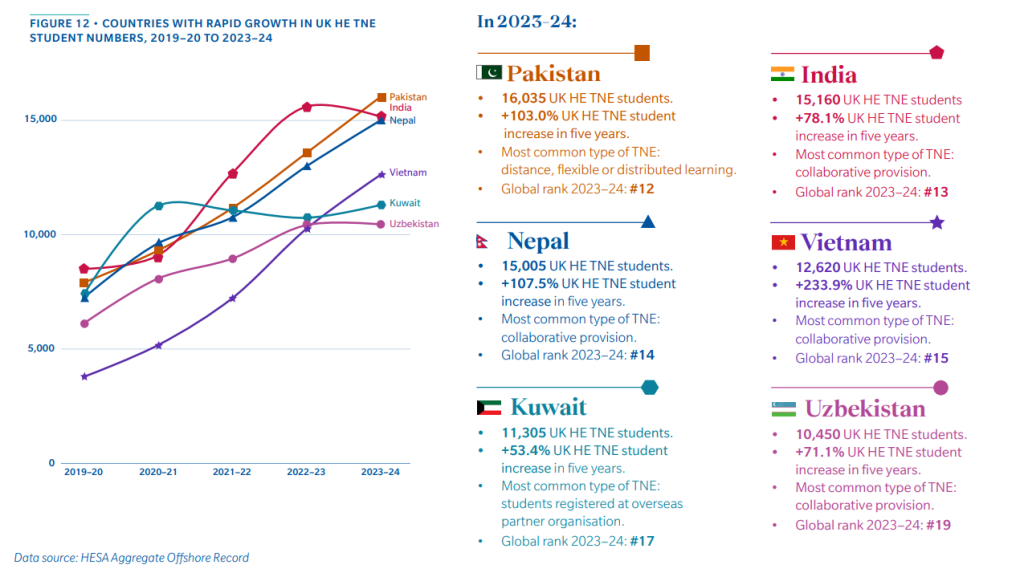
This shift is already visible. The most recent Universities UK ‘Scale of UK higher education TNE Report’, published in December 2025, shows there were 653,570 students enrolled on UK transnational programmes in 2023-24. Year-on-year growth remains strong and, if current trends continue, TNE numbers could overtake campus-based international student numbers.
Asia’s rise and subject-level competition
At the same time, the Times Higher Education World University Rankings by Subject 2026 make clear that the global competition for academic reputation is intensifying. Universities in Asia are improving across core subject rankings. This is particularly in STEM fields, where they are rising faster than many European and North American counterparts. These gains are part of a maturing global higher-education market where excellence is emerging across more regions.
That said, UK universities remain highly competitive. In the 2026 rankings, the UK holds 29 top-ranked subjects, matching the US.
Why it matters for UK universities
In the short term, this changes how performance is read. Flat or falling UCAS numbers no longer tell the whole story, particularly as growth may increasingly sit in transnational education and markets outside Europe.
At Hunterlodge, we see this as a positioning moment. As competition intensifies and more institutions globally improve their rankings, UK universities can no longer rely on historic reputation alone. “World class” must be evidenced clearly and consistently across markets. TNE is not only about expanding provision overseas. It is about protecting and strengthening reputation. Clear messaging around quality, outcomes and partnerships will matter more as competition grows.
For universities, this highlights the growing strategic importance of transnational education within international planning. UK universities can build on their academic reputation overseas, creating sustainable income, partnerships, and wider access to UK qualifications.
We’re always happy to discuss what this could mean in practice and how universities can better market their transnational provision overseas. For more information, contact kim.mclellan@hunterlodge.co.uk