
Over the past year, universities have tried to make sense of increasingly complex recruitment behaviour. Students are deciding later, postgraduate interest feels hesitant but persistent, and demand continues to concentrate around a narrower set of “safer” subjects.
It’s tempting to explain this purely through recruitment mechanics – deadlines, fees, or marketing saturation. But the evidence increasingly points to a bigger influence sitting behind student behaviour: the graduate labour market.
This perspective helps explain recent recruitment behaviour.
A graduate market that feels less certain
For students, the graduate jobs market currently feels more competitive and less predictable than in previous years – a factor that is increasingly shaping study decisions. ONS labour market indicators suggest that, although employment remains high, fewer vacancies and cautious employer hiring have made graduate outcomes feel less predictable.
This shift has also been acknowledged publicly by university leaders. Speaking to the Guardian, the Vice-Chancellor of King’s College London was clear:
“A degree is no longer a guaranteed passport to social mobility.”
What IDP data tells us about student behaviour
Recent IDP insights help illustrate how this labour market uncertainty is filtering into recruitment behaviour at both undergraduate and postgraduate level.
At undergraduate level, IDP data shows that 2026 remains the dominant focus, but with a notable persistence of research into the current intake year later in the cycle. This suggests students are keeping options open for longer, rather than committing early to a fixed pathway.
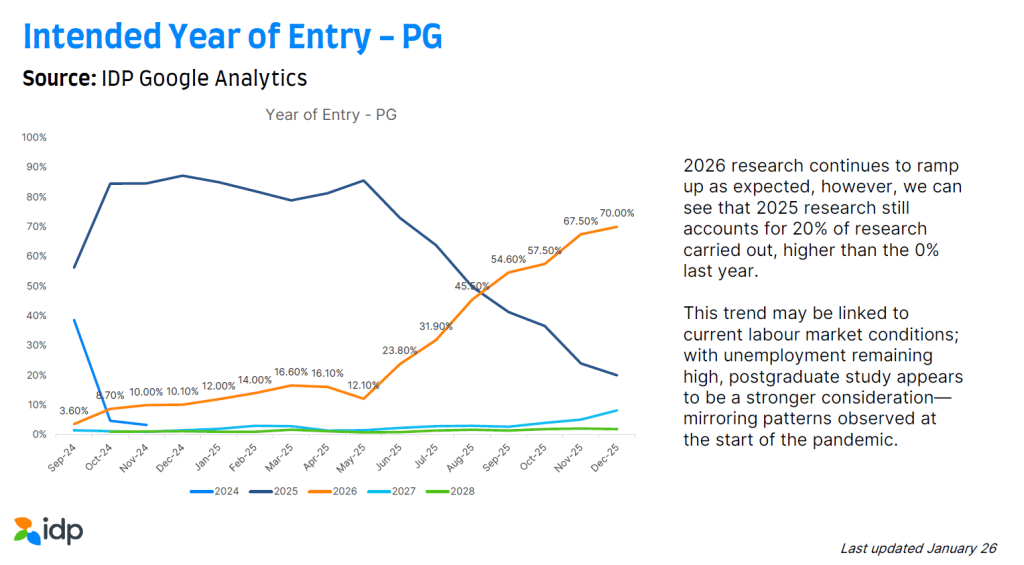
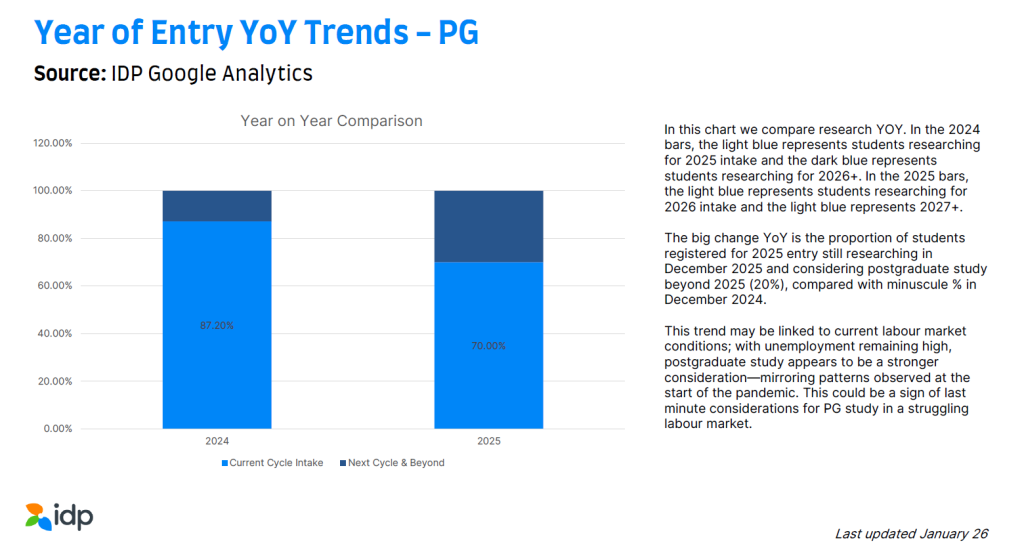
At postgraduate level, the signal is even clearer. A significant proportion of students are still researching 2025 entry well into December – this is a marked shift compared with the previous year. This suggests students are weighing up whether further study could improve their prospects.
Rather than representing disengagement, this behaviour points to deliberate risk management with students delaying commitment until they have greater clarity on employment prospects, finances and return on investment.
Taken together, the charts show that while most postgraduate research focuses on future intakes, a larger share of students were still considering the current intake by December than at the same point last year.
Subject demand reflects employability priorities
IDP course-level demand data also highlights how demand is concentrating around a narrower set of subjects. At undergraduate level, courses such as Law, Accounting and Finance, Psychology and Computer Science continue to dominate interest. At the postgraduate level, Computer Science, Nursing, and medical-related disciplines have seen less demand softening than other areas.
These choices aren’t about trends. They’re about reducing risk and improving job prospects. This mirrors what we see in UCAS end-of-cycle data, where higher-tariff and career-linked subjects have continued to perform more strongly than broader or less vocational areas
In uncertain conditions, students tend to gravitate towards courses that seem more predictable in terms of outcome – even if the competition is higher.
Why students are deciding later – and why that’s rational
What universities often read as hesitation or disengagement is, in fact, a rational response to labour market uncertainty.
When outcomes are uncertain, students keep their options open. Delaying commitment gives them flexibility.
IDP data showing stable high-tariff interest alongside declining demand at the lower end reinforces this. Students are not lowering expectations – they are becoming more selective and strategic. This also helps explain why open day demand drops seasonally while intent remains high among those still researching: fewer students are browsing casually, but those who remain active are serious decision-makers.
What this means for recruitment strategies
The implications for recruitment strategy are significant – and they challenge some long-held assumptions about student behaviour.
First, students are keeping their options open for longer. In our view, universities should plan for longer consideration windows and communicate consistently across the cycle, not just at key deadlines.
Second, employability messaging must move beyond headline statistics. Students are looking for specificity and proof – how skills translate, where graduates go, and what outcomes look like in practice.
Third, postgraduate recruitment should be positioned less as an automatic next step and more as a strategic choice with tangible outcomes, particularly in a competitive labour market.
Looking ahead
The data is clear: recruitment behaviour cannot be fully understood in isolation from the graduate labour market.
At Hunterlodge, our experience suggests that recruitment performance now hinges on clarity. Messaging needs to move beyond general reassurance and speak more directly to tangible outcomes.
Students are not disengaged. They are strategic.
For universities, the challenge is no longer just attracting attention. It is earning confidence in an environment where outcomes matter more than ever.
If you are reviewing how labour market pressures are influencing your recruitment performance, we are always happy to talk through what this could mean in practice.