
For decades, the path into university seemed relatively straightforward.
Achieve the grades, submit the application and, if successful, secure a place. Academic attainment was the primary measure of merit, and university admissions reflected that principle.
Today, however, the question of who gets into university is becoming increasingly complex.
Recent criticism of Russell Group universities over contextual admissions policies has reignited debate about fairness, standards and access. Reporting by Times Higher Education highlighted concerns that lower entry thresholds for disadvantaged applicants risk creating a divisive admissions system.
At the same time, universities are responding to a very different reality from the one that shaped admissions a generation ago. Rising living costs, widening participation targets, changing student demographics and the emergence of alternative qualifications are forcing universities to think differently about how they identify talent and potential.
The result is that university admissions are no longer simply about grades. Increasingly, they are about context.
The Debate Over Merit
The controversy surrounding contextual admissions raises a fundamental question: what should universities reward?
For critics, admissions should remain focused on academic attainment. A grade achieved is a grade achieved, regardless of a student’s background.
For supporters, that view ignores the reality that students do not all begin from the same starting point.
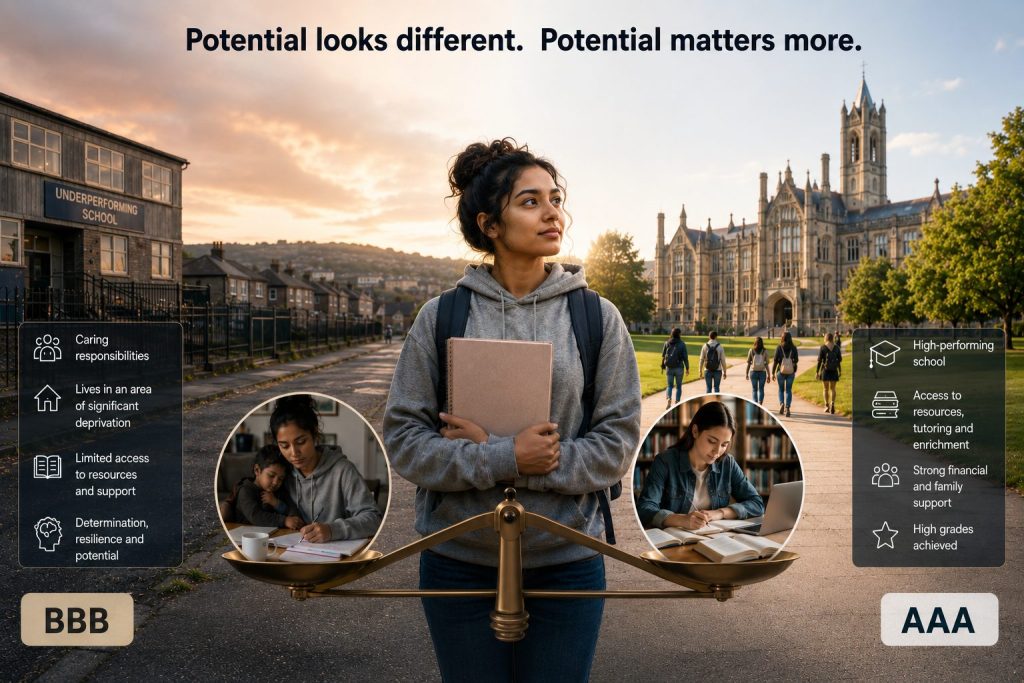
A student who achieves BBB while attending an underperforming school, balancing caring responsibilities or living in an area of significant deprivation may have demonstrated as much academic potential as a student achieving higher grades with greater educational and financial support.
This principle underpins contextual admissions, which allow universities to consider factors beyond examination results when assessing applications. As a result, admissions teams are increasingly interested not only in what students achieved, but in the circumstances in which those achievements were earned.
The debate is unlikely to disappear. As universities seek to widen participation while maintaining public confidence in admissions standards, questions about fairness will remain central to discussions about access. The aim is not to lower standards. Rather, it is to identify potential that may otherwise be overlooked.
The Rise of the Commuter Student
While the debate around contextual admissions focuses on fairness and opportunity, universities are also responding to a more practical challenge: affordability.
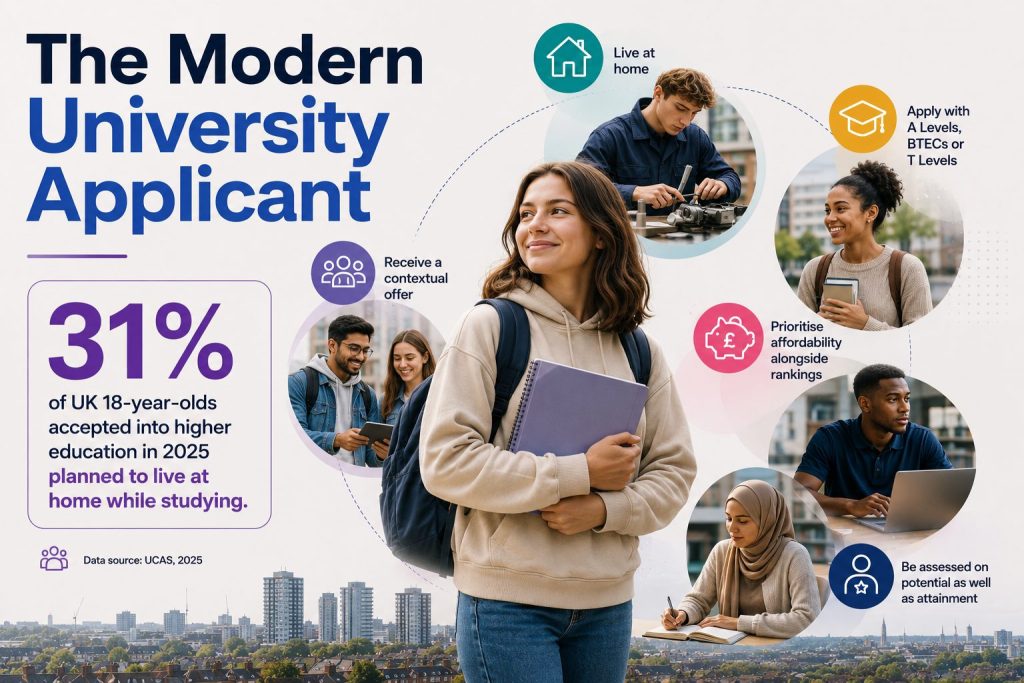
According to UCAS, almost 90,000 UK 18-year-olds accepted into higher education in 2025 planned to live at home while studying, representing 31% of accepted applicants. A decade ago, the figure was closer to 22%.
Recent reporting by The Times found that more than half of students from the most disadvantaged backgrounds now commute to university rather than move away from home.
This shift reflects the growing financial pressures facing prospective students.
Rising accommodation costs, increasing living expenses and graduate debt levels that now regularly exceed £50,000 mean many applicants are making decisions based on affordability as much as academic aspiration.
The traditional image of the student moving hundreds of miles away to begin an independent life is becoming less representative of the modern university experience.
More Routes Into Higher Education
Alongside A Levels, applicants may arrive with BTECs, T Levels, Access to Higher Education qualifications and a wider range of educational experiences than ever before.
Universities are recruiting from an increasingly diverse range of educational backgrounds, reflecting a broader shift away from the traditional one-size-fits-all admissions model.
This diversification presents both opportunities and challenges.
Admissions teams must assess a broader range of qualifications while ensuring applicants are prepared for the academic demands of their chosen course.
At the same time, institutions are under pressure to demonstrate that higher education remains accessible to talented students regardless of background.
The result is a more flexible admissions landscape than at any point in recent memory.
Admissions Under the Spotlight
The debate around contextual admissions is unfolding at a time when universities face growing scrutiny over recruitment more broadly.
Alongside questions about widening participation and access, institutions are also under increased pressure from the government to monitor international recruitment. Recent proposals reported by The Independent suggest universities could face sanctions if too many international students are found to be misusing study visas or later claiming asylum in the UK.
While the issues are distinct, they point to a common theme: admissions decisions are becoming increasingly politicised.
Universities are under growing pressure to attract enough students to remain financially sustainable while also demonstrating that they are widening access, supporting social mobility and recruiting responsibly. For admissions teams, that means greater scrutiny over who is admitted, how potential is assessed, and what fairness looks like in practice.
So Who Gets Into University?
The debate sparked by contextual admissions, commuter students and changing entry routes points to a broader shift in higher education.
Universities are under pressure to recruit enough students to remain financially sustainable while also widening participation, supporting social mobility and maintaining public confidence in the admissions process.
As a result, the question is no longer simply who achieves the highest grades. Increasingly, universities are being asked to consider potential, circumstance, and opportunity alongside academic attainment.
In 2026, who gets into university is no longer a straightforward question – and that may be the biggest change of all.
At Hunterlodge, we help universities translate sector trends into meaningful engagement strategies that connect with prospective students. Get in touch to find out how we can help your institution connect with tomorrow’s students: Kim.mclellan@hunterlodge.co.uk