
There’s no shortage of AI in higher education right now. Chatbots are everywhere, automation is expanding, and almost every institution can point to something “AI-powered” in recruitment.
But after tuning into a recent Keystone Education Group webinar on what “meaningful AI” in student recruitment actually looks like, a different picture emerges: most of this activity isn’t changing outcomes.
Universities are under growing financial pressure. The Office for Students has warned that nearly half of English providers could be in deficit in 2025–26.
International recruitment is also less predictable. Policy changes and visa restrictions are affecting demand. Times Higher Education has reported growing concern that overseas students are no longer a reliable solution for funding gaps.
Recent reporting by The Times has also raised concerns about the quality and preparedness of some students on these courses.
Given all of this, recruitment is not just about volume. It is about credibility. And it is about conversion.
Universities are investing in visible AI, not decision-making AI
The webinar makes a useful distinction. Universities are investing in the visible layer of AI, not the decision layer.
The visible layer is what we’re seeing everywhere:
- chatbots answering enquiries
- automated responses
- workflow tools that speed things up
These improve efficiency and signal progress. But they do not necessarily improve conversion.
What’s missing is the layer that drives enrolment decisions:
- which students to prioritise
- when to intervene
- what kind of support will make a difference
This is partly due to how quickly AI has been adopted. Tools like ChatGPT have been taken up at speed across the sector.
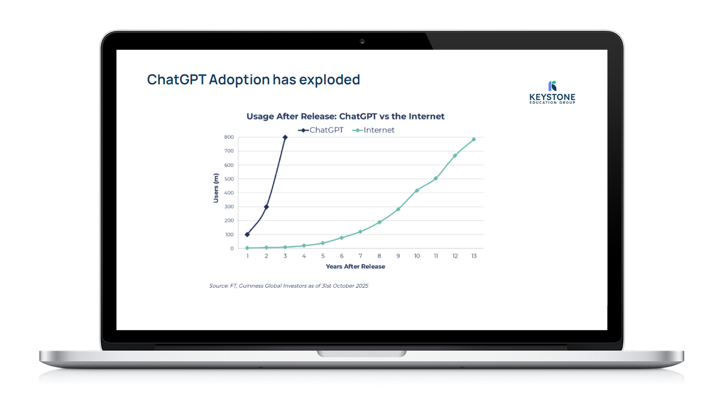
The sector is under pressure to convert better, not just recruit more
Instead of treating applicants as a single pool, universities need to distinguish between:
- highly engaged students
- uncertain students
- students who are likely to drop out
Without that, time is spread too thinly. Effort goes to the wrong places.
Most current approaches increase activity, but do not improve prioritisation – a growing limitation in a more competitive and unpredictable market.
Recruitment does not behave like a campaign funnel
Much of university marketing still follows a campaign model. Generate leads. Follow up. Move students through a funnel.
That is not how decisions actually happen. Student recruitment is a relationship, not a transaction.
One slide in the webinar maps a single student journey over nine months – moving between WhatsApp, webinars, emails and phone calls before enrolment.
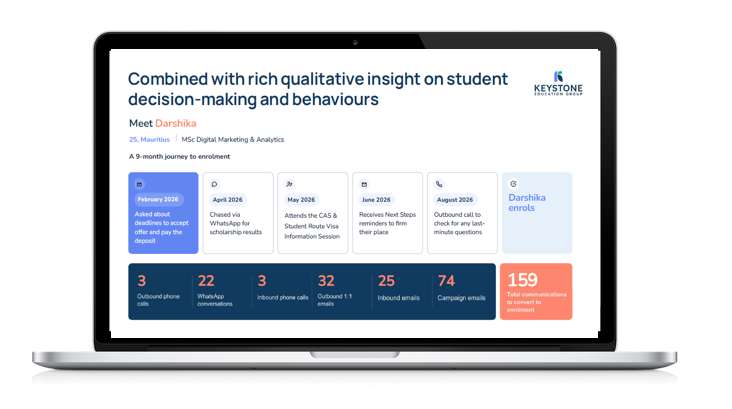
This journey is shaped by timing, context and changing needs.
Campaign-based approaches struggle to manage this. They are too rigid and time-bound. What is needed is continuous, responsive engagement.
The real shift is from reacting to predicting student behaviour
Instead of treating all applicants equally, the approach described in the webinar uses propensity modelling. Each student is given a likelihood to enrol, based on behaviour, and that score updates over time.
Without it:
- enquiries are handled in order
- disengagement is hard to detect
- outreach relies on instinct
With it:
- effort is prioritised
- at-risk students are identified earlier
- engagement becomes targeted
This is standard in other sectors, but still emerging in higher education.
Faster responses do not drive decisions – relevant ones do
Speed has been a major focus in recent years. Faster replies. Instant chat. Always-on communication.
But speed alone is not enough. The webinar makes a clear point. Speed matters up to a threshold. After that, relevance and timing matter more.
Students do not choose a university because it replied first. They choose based on whether the interaction was useful at the right moment.
Data is becoming a bigger advantage than brand alone
The approach described in the webinar draws on years of interactions across multiple institutions.
No single university can build that alone. Competitive advantage is no longer just about brand or budget. It is also about access to better data and stronger infrastructure.
There is also a growing visibility challenge emerging around AI search itself.
AI systems do not provide a broad or balanced view of the sector. Source reuse is common, visibility is concentrated around a relatively small group of universities, and aggregator sites are frequently surfaced for comparison-based queries.
Results also vary significantly across platforms and query types. In practice, many AI-generated answers reflect the limitations of their source pool rather than a comprehensive view of the market.
That creates another pressure for universities. It is no longer just about ranking well in traditional search. It is about being present in the sources AI systems repeatedly rely on.
AI can identify the moment – but marketing still has to deliver the message
AI can help identify who to prioritise and when to engage. But it cannot replace the message.
Once the timing is right, the question remains:
Why this university?
And that still depends on relevance and communication.
At Hunterlodge, this is already shaping how we approach student recruitment with our clients.
We are seeing a shift away from campaign-led activity towards more continuous, insight-driven engagement. The focus is less on volume and more on where effort will have the greatest impact.
Tools are only part of the answer. The real value comes from how data, timing and messaging work together to support better decisions across the student journey.
Universities do not need more activity. They need better prioritisation, clearer messaging, and a more connected view of how students move from enquiry to enrolment.
If you’re looking to improve how you prioritise and convert prospective students, we’d be happy to talk: nick.friend@hunterlodge.co.uk