
But look beyond the headline and there are signs that the decline may be easing.
The Home Office’s September 2026 visa statistics, published on 8 October, show that Sponsored Study visa applications from main applicants fell by 19% in the year ending September 2026, to 352,500.
That’s a substantial decline, and a worsening of the 16% annual fall reported in August.
But the monthly figures tell a different story.
The decline may be slowing
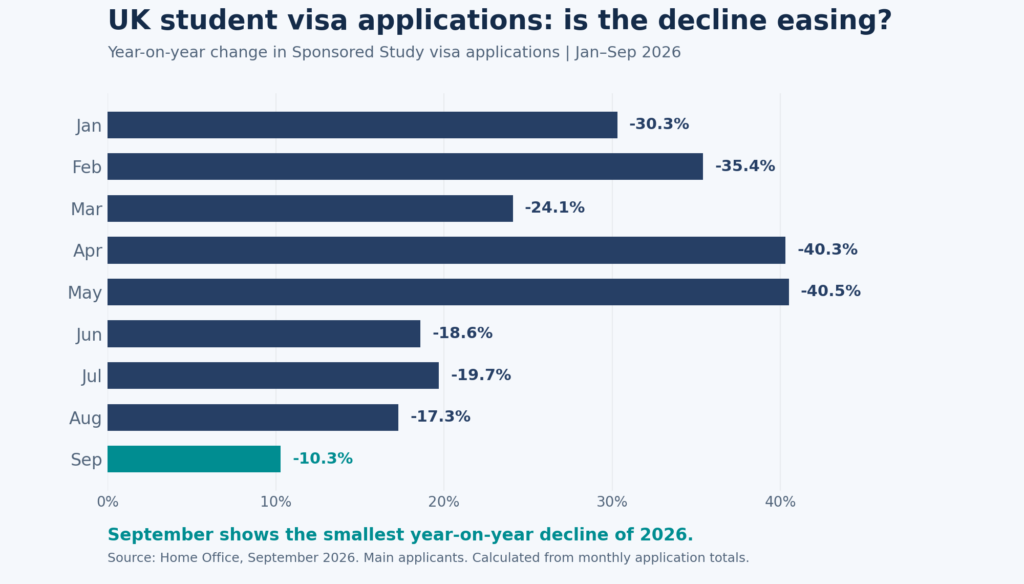
Looking at individual months rather than the rolling annual total, the latest figures suggest the pace of decline may be moderating.
In April and May, Sponsored Study visa applications were down around 40% compared with the same months in 2025. Since then, the year-on-year decline has generally narrowed, falling to 19.7% in July, 17.3% in August and 10.3% in September.
September represents the smallest year-on-year decline recorded so far in 2026.
However, the longer-term picture remains challenging. As Times Higher Education reports, September applications were at their lowest level for five years, while applications across the crucial July-to-September recruitment period were 26.4% below 2023 levels.
The distinction matters. Rolling annual figures reflect applications over the previous 12 months, while monthly data provides a more immediate indication of what is happening in the current recruitment cycle.
An improving trend in the rate of decline isn’t the same as a recovery in application numbers, but it is a more encouraging picture than the headline 19% fall might suggest.
Where is recruitment under pressure?
The September release doesn’t provide a breakdown by country or subject, but earlier Home Office immigration statistics highlight some important differences.
In the year ending June 2026, Sponsored Study visas granted to Pakistani nationals fell by 47% and to Indian nationals by 16% compared with the previous year.
Postgraduate recruitment also remains a concern. Around 62% of students granted Sponsored Study visas come to the UK for master’s-level study, and the latest available figures show master’s visa grants down 3% year on year.
Although these figures come from an earlier reporting period and measure visa grants rather than applications, they reinforce why universities need to look beyond overall numbers when assessing international recruitment performance.”
But UCAS is showing a different picture
The Home Office figures contrast with UCAS data, which showed international undergraduate acceptances up 2% on Results Day, rising to around 4% in subsequent updates.
However, the figures measure different things. UCAS tracks undergraduate acceptances, while Home Office visa applications cover both undergraduate and postgraduate students.
This suggests international recruitment may be performing differently across levels of study, reinforcing the importance of looking beyond the headline figures.
What does this mean for universities?
The September figures offer some grounds for cautious optimism, but uncertainty remains.
For universities, the important question isn’t simply whether international demand is rising or falling overall. It’s understanding which markets and levels of study are performing well, where demand is weakening and how successfully prospective students are progressing from initial interest through to enrolment.
The next few months of data will be important in establishing whether September represents the beginning of a sustained improvement or simply a temporary moderation in the decline.
Want to understand what the latest international recruitment trends mean for your university? Get in touch with the Hunterlodge team