
Getting a prospective student to make an enquiry should be a valuable moment in the recruitment journey.
They’ve moved beyond simply seeing an advert, visiting a website or comparing courses. They have a question and have actively chosen to engage with a university.
But new research suggests universities aren’t always making enough of that opportunity.
The findings have already attracted attention across the sector, with Times Higher Education reporting that indifferent responses to student enquiries could be ‘costing enrolments’.
The 2026 Enquiry Experience Tracker, produced by Edified and informed by UniQuest, mystery-shopped domestic student enquiries across 63 UK and Australian institutions. This year’s research was the first dedicated study of domestic student enquiries.
And the UK results are interesting.
UK universities answered 91% of student enquiries within the time allowed by the research. So getting a response isn’t necessarily the problem.
The bigger question is whether that response gives the student a reason to keep engaging.
Answering isn’t the same as engaging
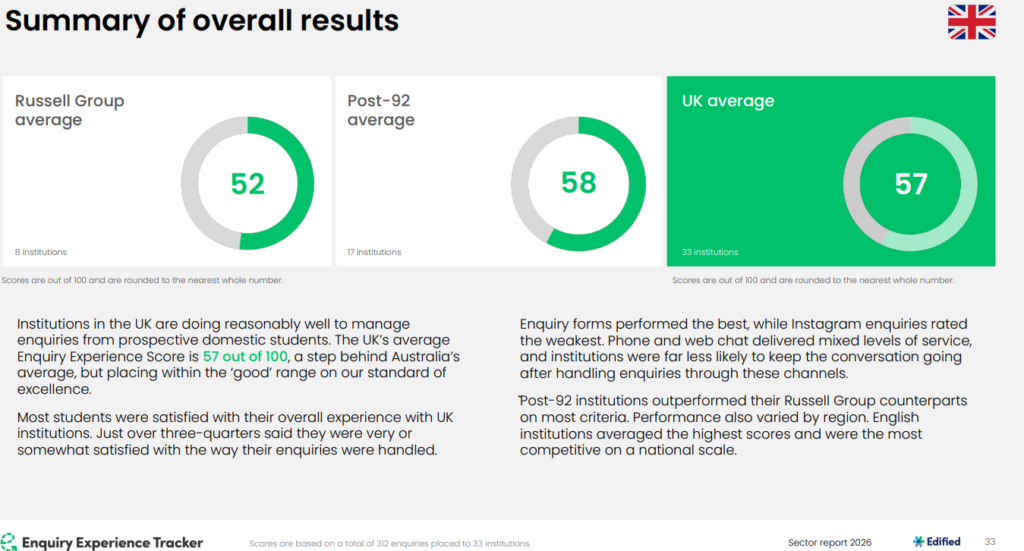
Across the 33 UK universities assessed, the average Enquiry Experience Score was 57 out of 100, compared with 63 in Australia.
Perhaps surprisingly, Post-92 universities scored 58, compared with 52 for Russell Group universities.
The research found that around 40% of UK responses were rated ‘excellent’ for communication quality. Replies were generally clear and relevant, but half missed the opportunity to persuade.
Only one in five included content such as videos or student stories, fewer than a third highlighted key selling points and around half of students felt responses lacked genuine care.
That’s important. An enquiry isn’t simply a question to answer. It’s another opportunity to demonstrate why a student might choose you.
And then there’s the follow-up
This is perhaps where the biggest opportunity lies.
The UK’s average score for follow-up was just 2 out of 10, putting it in the report’s ‘poor’ category.
Only a third of UK students received further communication – whether through nurture campaigns, personal emails, texts or calls – after their initial enquiry had been answered. Among Russell Group universities, fewer than one in four students received follow-up.
For universities investing significant budgets in generating leads, website traffic and enquiries, that’s potentially a sizeable gap in the recruitment journey.
AI is raising the bar
Another finding really stood out.
For 187 enquiries, mystery shoppers also asked ChatGPT the same question.
71% said ChatGPT met their needs better than the university response.
And this wasn’t simply because AI was faster. Students described 95% of ChatGPT replies as informative, interesting or motivating. They were also more likely to have a positive impression of the university after receiving the ChatGPT response – 60% compared with 53% following the university’s own response.
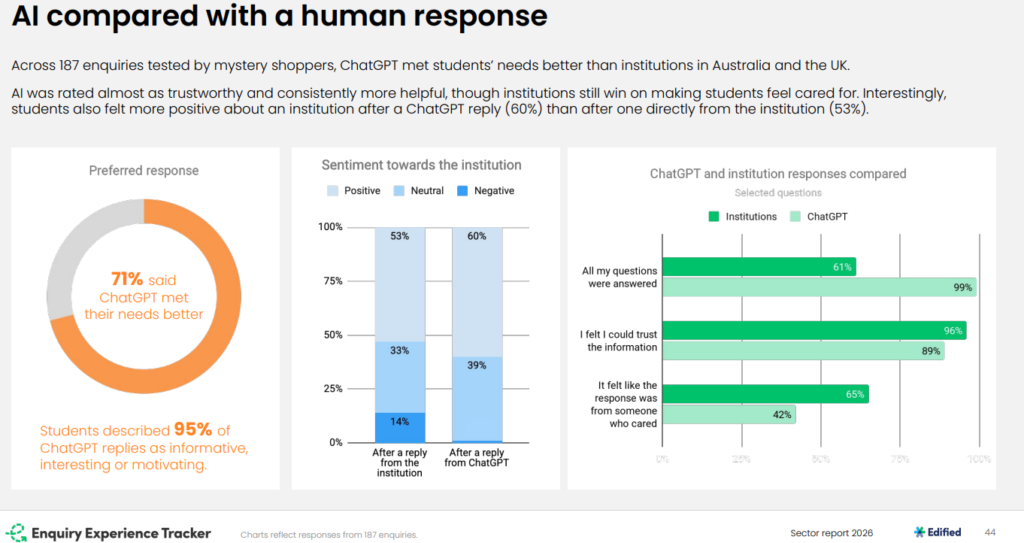
The research also found that:
ChatGPT included a reason to choose that university in 50% of responses, compared with only 30% in university responses.
That’s a striking finding for recruitment teams.
But it doesn’t mean universities need to try to beat AI at being AI.
The human response should be the advantage
Students already have instant access to information through AI and search. What universities can offer is something those tools can’t easily replicate: understanding an individual’s circumstances, applying judgement and making someone feel genuinely welcomed and wanted.
The research itself found exactly that. While AI performed particularly well at the information task, the human advantage came through understanding the individual, institution-specific advice, judgement and a genuine sense of care.
So perhaps the challenge isn’t simply to answer enquiries faster. It’s to make the interaction worth having.
Making more of the demand you already have
Last month, we looked at this issue from an international perspective in International student demand is there – but converting it is getting harder.
This research looks at domestic students, but it highlights another part of the same recruitment challenge.
Universities spend heavily generating awareness, website visits, Open Day registrations and enquiries. Improving conversion doesn’t always have to mean generating more leads.
It can also mean making more of the students who have already put their hand up.
That means looking at what happens after an enquiry: Was their question properly answered? Was the response personal? Did it give them another reason to choose you? And did anyone continue the conversation?
As AI makes basic information easier than ever to access, those human interactions could become more important, not less.
Want to make more of your student enquiries? Get in touch with the Hunterlodge team mailto:nick.friend@hunterlodge.co.uk