
The global higher education (HE) sector is undergoing profound change in 2025, driven by technological innovation, shifting demographics, and evolving workforce expectations. These dynamics are altering how institutions operate, what skills they prioritise, and whom they serve. While rising costs and skills mismatches present significant challenges, there are also promising opportunities, from the growing demand for STEM education in Africa and Asia to the expanding potential of artificial intelligence and sustainability initiatives. As global pressures escalate, higher education must adapt swiftly to remain relevant, inclusive, and impactful in an increasingly interconnected world.
Challenges
Affordability remains a pressing issue globally. Rising tuition fees, combined with increasing living costs, are making higher education less accessible in many regions, including North America, Europe and Asia (ICEF Monitor, 2023; HESA, 2024). This financial strain risks deepening social inequality and limiting opportunities for students from disadvantaged backgrounds.
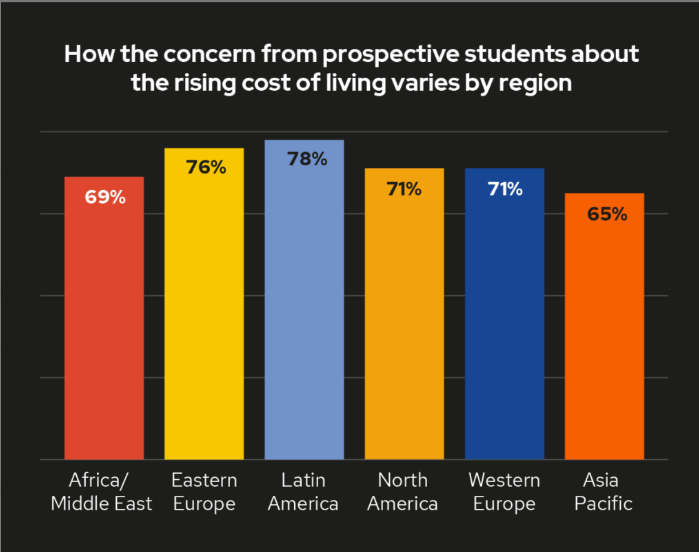
According to QS’s 2024 International Student Survey, 69% of students cite living costs as their biggest concern – underscoring the urgent financial pressures that could threaten plans for study abroad
Another major challenge is the mismatch between graduate skills and labour market demands, which affects many economies worldwide. Graduates often find their qualifications do not align with employer expectations, highlighting the urgent need for institutions to adapt curricula and build stronger partnerships with industry. This is showcased clearly in an article from The Economist which explores the decline of graduate employment across the world. For instance, in America, the amount of Stanford business-school students entering the workforce within three months of graduation has fallen by 11% in just three years (2021-2024). Similarly in Europe, fewer young people are securing jobs in prestigious sectors like finance. This shift partly reflects a growing recognition among employers that non-graduates can perform roles traditionally reserved for degree-holders only. They may also be seen as favourable to employ as their skills are more malleable to specific workplace environments than students with a background in higher education coming in with strong preconceptions, on top of higher salary expectations.
Meanwhile, subjects like arts, humanities and social sciences are increasingly subsidised, attracting students who may view them more as personal interests than career investments, often resulting in limited job prospects. They may also lack awareness of how oversaturated some of these fields are, making it difficult to obtain a viable lifestyle after finishing their degree. Social media further influences younger generations’ attitudes toward higher education, contributing to a declining interest in traditional employment and a growing fixation on becoming influencers, as the concept of alternative “dream jobs” become less fulfilling. More focus may be needed on reshaping how work is portrayed to younger people, making ‘effort’ and employment more desirable, rewarding and something with meaning worth striving for.
Opportunities
Demand for STEM education is rising significantly across emerging regions. In Africa, UNESCO reports that to meet future demands, the continent will need around 23 million additional STEM graduates by 2030, making STEM education a key driver of innovation and sustainable development. Meanwhile, that same report highlights rapid population growth in Africa, projecting that by 2030, African youth will make up approximately 42 percent of the global youth population – showcasing the urgency in scaling STEM training (UNESCO, 2023).
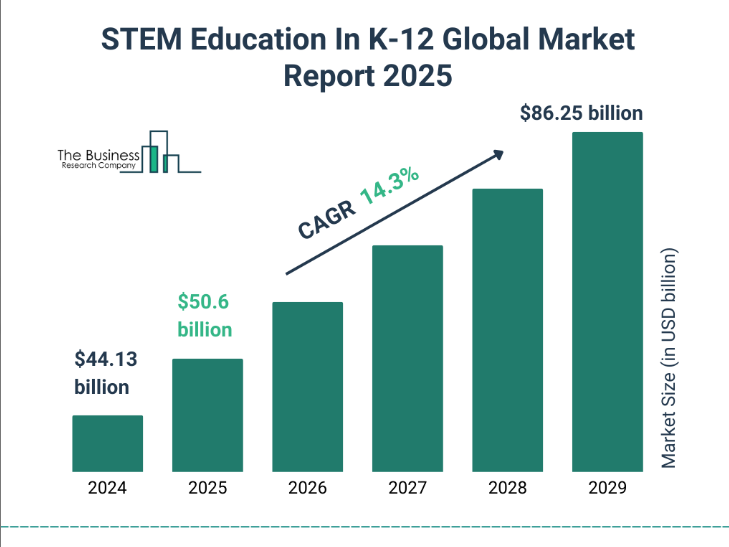
This graph shows global investment in STEM education tools and services nearly doubling by 2029, highlighting rising demand for early science and tech learning – Source: The Business Research Company (2025).
In Asia, data from Studyportals reveals growing interest in English-taught STEM programmes, with a notable difference in fields such as Medicine & Health (+12.3%) and Computer Science (+6.7%). This reflects the continent’s expanding middle class and increased investment in domestic universities, positioning Asia not only as a supplier of international students but as a developing study destination itself (Studyportals, 2024).
Taken together, these trends indicate that regions across the Global South, Africa and Asia in particular, will account for an increased share of global STEM enrolment, presenting both immense opportunity and responsibility for higher education providers to diversify student access and respond to shifting workforce demands.
The rise of artificial intelligence (AI) also brings major potential worldwide. While concerns around academic integrity remain, AI can enhance personalised learning, streamline administrative tasks, and improve student support services (McGraw Hill, 2024). Institutions that implement AI effectively will improve both educational outcomes and operational performance.
Additionally, universities are playing an increasingly important role in addressing global sustainability and climate related challenges. Higher education institutions across the world are embedding sustainability principles into teaching and research, positioning themselves as key contributors to social responsibility and environmental stewardship (OECD, 2023). This focus strengthens the sector’s relevance and social/global impact.
Final thoughts
The global higher education sector stands at a pivotal crossroads. By addressing persistent issues such as affordability and employer values, while embracing AI, sustainability, and equitable access, institutions can navigate today’s challenges and take control of future opportunities. In doing so, higher education will continue to serve as a powerful engine of inclusive economic development and societal progress worldwide.
At Hunterlodge, we understand the shifting pressures and possibilities facing higher education. From helping universities position themselves in a crowded market to building data-led campaigns that speak directly to student values, we bring insights and strategy that drive real outcomes. Whether you’re seeking to attract STEM students from Africa or reposition your brand around sustainability and employability, we provide tailored marketing solutions that deliver impact, inclusivity, and innovation.
References
ICEF Monitor (2023) ‘Five international education trends that will extend into 2024’, ICEF Monitor, 15 December. Available at: https://monitor.icef.com/2023/12/five-international-education-trends-that-will-extend-into-2024 (Accessed: 3 July 2025).
HESA (2024) Higher Education Student Statistics: UK, 2023/24. Available at: https://www.hesa.ac.uk/data-and-analysis/students (Accessed: 3 July 2025).
McGraw Hill (2024) ‘2024 Global Education Insights Report’, McGraw Hill. Available at: https://www.mheducation.com/news-insights/press-releases/2024-global-education-insights-report.html (Accessed: 3 July 2025).
OECD (2023) Trends shaping education 2025, OECD Publishing. Available at: https://www.oecd.org/en/publications/trends-shaping-education-2025_ee6587fd-en/full-report/global-trends-and-the-future-of-education-in-2025_7358e77a.html (Accessed: 3 July 2025).
Studyportals (2024) Leveraging the Asian decade in international education. Available at: https://studyportals.com/articles/leveraging-the-asian-decade-in-international-education/ (Accessed: 3 July 2025).
UNESCO (2023) What you need to know about the challenges of STEM in Africa. Available at: https://www.unesco.org/en/articles/what-you-need-know-about-challenges-stem-africa (Accessed: 3 July 2025).
The Economist (2025) “Why today’s graduates are screwed”, The Economist. Available at: https://www.economist.com/finance-and-economics/2025/06/16/why-todays-graduates-are-screwed (Accessed: 4 July 2025).