
The clearest shift is at master’s level; undergraduate growth is real, but more concentrated.
For years, the UK higher education conversation has centred on why universities might invest in online learning. The more revealing question now is whether they actually are. The answer is increasingly yes – but not as a simple, sector-wide boom.
From isolated courses to portfolio strategies
Manchester’s 2035 strategy is one of the boldest signals. The university aims for half of its students to study online through Manchester Online or through workplace routes, placing digital delivery firmly within its long-term model.
But Manchester is no longer an unusual case. Southampton has created a dedicated Southampton Online brand, developed with CEG Digital, with fully online master’s pathways across areas including artificial intelligence, management, logistics and sustainability. Lancaster announced a partnership with 2U in 2025 to deliver 15 new online postgraduate degrees over three years, while Surrey’s agreement with 2U included plans for at least 15 online master’s degrees and 15 professional certificates.
The pattern has continued into 2026, with further online master’s launches from institutions including University of the Arts London, Glasgow and Exeter.
Heriot-Watt shows how the model can extend beyond degrees. Heriot-Watt Online acts as a distinct gateway to its programmes, while its Professional Academy offers self-paced, credit-bearing short courses that can stack towards a certificate, MSc or MBA.
Taken together, this looks less like a collection of individual experiments and more like an emerging portfolio strategy: degrees, shorter learning opportunities and progression routes brought together under distinct online propositions.
The shift is strongest at master’s level
The latest available HESA data provides the clearest evidence of the shift.
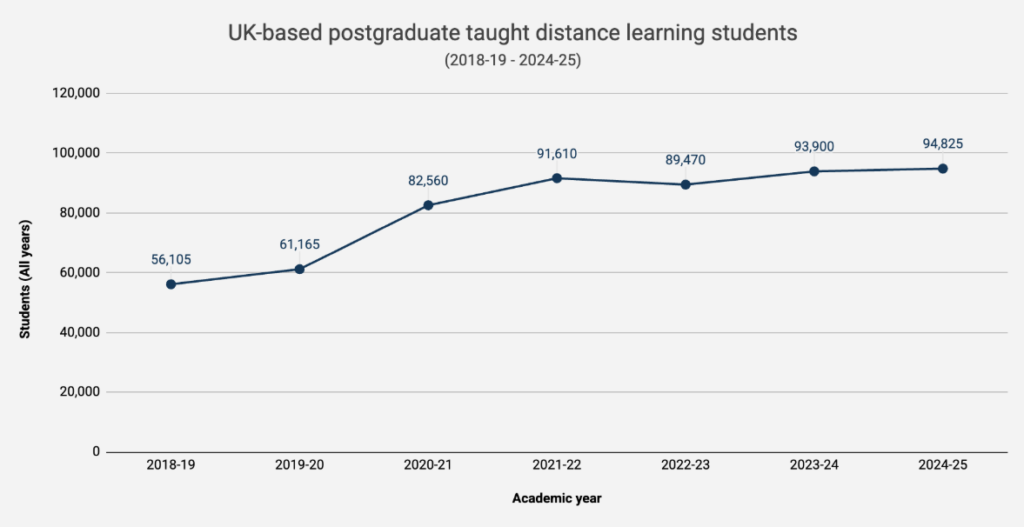
Analysis by online learning consultant Neil Mosley shows UK-domiciled online postgraduate taught enrolments rising from 56,105 in 2018/19 to 94,825 in 2024/25 – an increase of around 69%.
Online PGT numbers edged upwards again in 2024/25, while the wider UK-domiciled postgraduate market declined slightly.
Growth is also spread across a much wider market. In 2017/18, only 10 providers had more than 1,000 UK online postgraduate students; by 2024/25 there were 32. In the latest year alone, 33 HE providers increased their online PGT numbers by at least 100 students.
That breadth matters. Online postgraduate study is no longer the preserve of a small number of specialist providers, although performance varies considerably between institutions.
It also reflects what universities are launching. Many recent online master’s programmes are in career-linked areas such as AI, data science, cyber security, management, marketing and sustainability – subjects that can appeal to graduates wanting to progress their career, change direction or build specialist expertise without stepping away from work or relocating.
Is undergraduate provision following?
Yes, but the picture is more mixed.
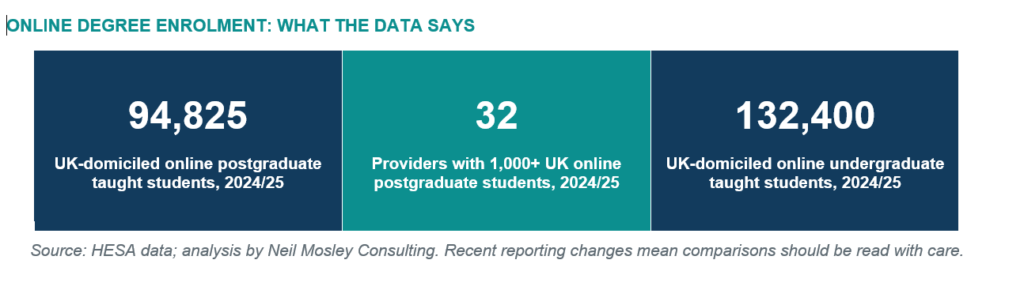
UK-domiciled online undergraduate enrolments stood at around 132,400 in 2024/25, but fell 2% on the previous year. At first glance, that appears to tell a very different story from postgraduate study.
However, the Open University accounts for around 78% of this market, and its enrolments fell by 4,400 in 2024/25. That makes the overall figure potentially misleading when assessing what is happening elsewhere.
Remove the Open University and a different longer-term pattern emerges. Online undergraduate enrolments across other institutions have risen from 8,440 in 2014/15 to around 29,200 in 2024/25.
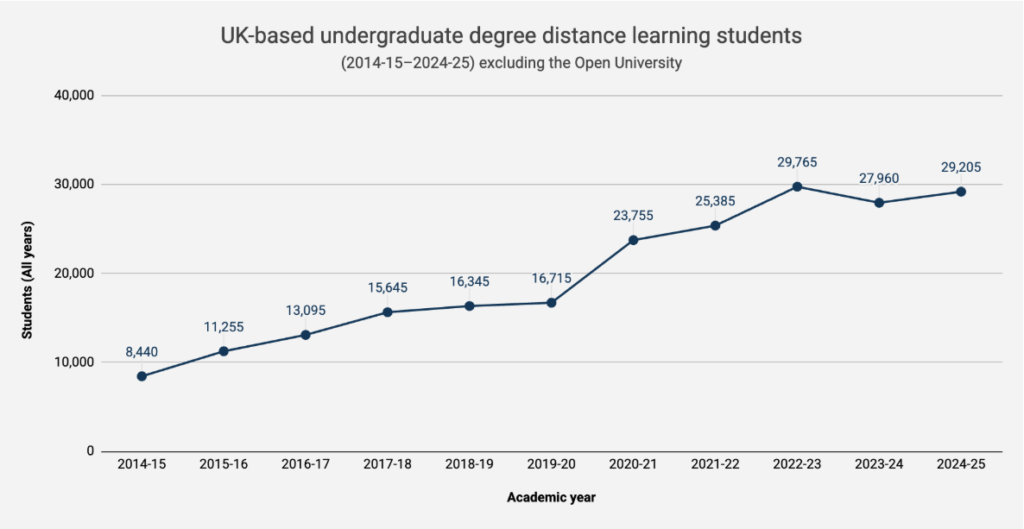
It is a smaller and more gradual expansion, with a growing number of institutions developing online undergraduate routes beyond the market’s traditional dominant provider.
Internationally, there is another dimension. Online transnational undergraduate enrolments rose 6% in 2024/25 to 55,490, continuing annual growth since 2019/20. The University of London remains the dominant provider, but other institutions are also growing their international online populations.
More courses mean more competition
Expansion does not guarantee easy growth.
The latest provider-level data includes both strong gains and significant declines. As more institutions enter the market, prospective students have more choice – and universities have to work harder to explain why their course is different.
This is where the story moves from course production to positioning.
A credible online offer needs more than recorded lectures and a flexible timetable. It needs a clear audience, a distinctive subject proposition, visible academic and student support, evidence of community and a simple route from initial interest to application.
Universities that treat online as a distinct market with its own audiences, motivations and recruitment journey – rather than simply a campus programme delivered differently – are more likely to build sustainable demand.
Why flexibility matters to learners
There is evidence that flexibility increasingly matters to students.
Jisc’s 2024/25 Digital Experience Insights survey of more than 15,000 UK higher education students found that 48% would prefer online or blended learning rather than purely campus-based teaching, while 36% said the cost of travel had deterred them from attending campus.
At the same time, the 2026 HEPI/Advance HE Student Academic Experience Survey found that 65% of full-time undergraduates are in paid employment during term time. While slightly down from 68% in 2025, paid work remains the norm for a clear majority of students, reinforcing the importance of being able to fit study around other commitments.
These findings don’t mean students universally prefer fully online degrees. But they do help explain why flexibility, reduced travel and the ability to fit study around work and other commitments have become increasingly important parts of the proposition.
Flexibility is also about how much someone commits and where they study.
Surrey’s professional certificates were designed to help learners build skills as they decide whether a full degree is right for them. Heriot-Watt’s Professional Academy allows learners to start with an individual course and stack credit over time. For some prospective students, the first conversion may therefore not be into a master’s programme at all, but into one manageable piece of learning that allows them to test the subject build confidence and potentially progress towards a larger qualification.
Policy is beginning to move in this direction too. From January 2027, England’s Lifelong Learning Entitlement will extend tuition-fee funding to eligible courses, including designated distance and online provision. Funding for individual modules will initially be more limited, but the direction is significant: the funding system is beginning to accommodate higher education undertaken in smaller stages rather than always as one continuous programme.
Sarah Artis, our Group Account Director at Hunterlodge, commented:
“The biggest change we’re seeing through our work with Heriot-Watt and the University of London is that online is no longer being treated as an add-on. The strongest offers give people different ways in – from a short course to a certificate or full degree. That changes the recruitment journey too: the first job isn’t always to sell the degree, but to make that first step feel relevant, valuable and achievable.”
The financial context, not the main story
This expansion is happening while university finances remain under pressure. The Office for Students says four in ten English providers could report a deficit in this academic year, making new recruitment routes and more diversified income understandably attractive.
But online learning is not a cheap rescue plan. It requires investment in course design, technology, academic time, student support and sustained marketing if qualifications are to be seen by students and employers as credible and valuable in their own right.
Finance helps explain the urgency. It does not prove demand. The stronger evidence comes from rising postgraduate enrolments, growth across a wider range of providers and indications that flexibility increasingly matters to learners.
A wider shift – and a more competitive market
Taken together, the evidence points to a genuine shift. Dedicated online brands, multi-programme launches, platform partnerships and stackable pathways are becoming a more established part of UK higher education.
But as more universities enter the market, simply offering an online degree becomes less distinctive.
The competitive question moves from “Should we offer online?” to “Why should somebody choose our online programme rather than someone else’s?”
That puts greater pressure on universities to understand exactly who each programme is for, articulate its career and academic value, build confidence in the quality of the online experience and make the route into study as simple as possible.
Short courses and stackable qualifications could also become an increasingly important part of that journey, giving prospective learners a lower-commitment entry point into a longer relationship with a university.
The next phase of online higher education will therefore not be defined simply by how many programmes universities launch. It will be defined by whether those offers can stand out in an increasingly crowded market and answer the questions prospective learners are really asking:
Can I fit this into my life? Can I trust the experience? Can I start without overcommitting? And will it take me somewhere valuable?
Looking to grow your online offer? Talk to Hunterlodge about how we can help. nick.friend@hunterlodge.co.uk