
The report draws on international student research conducted between January and April 2026, alongside QS Global Student Flows forecasts from October 2025.
QS forecasts UK international enrolments to grow by around 3.5% annually to 2030, the strongest projected growth amongst the traditional ‘Big Four’ study destinations.
That’s encouraging, and this year’s UCAS data also points to strong interest. International undergraduate applications were up 7.1% year-on-year by the June deadline, with China performing particularly strongly.
But applications are only part of the story. Two weeks on from Results Day, international acceptances were 4% ahead year-on-year – positive growth, but still some way behind the 7.1% increase in applications seen at the June deadline.
For us, that’s perhaps the most interesting story: international demand is there, but converting it is getting harder.
The UK is attractive – but value matters more
The UK’s academic reputation remains a major strength. QS found 58% of UK-bound students prioritise high-quality teaching, while more than half still perceive the UK as an attractive destination.
But there is an obvious tension: 59% see the UK as expensive, and only 10% see it as affordable.
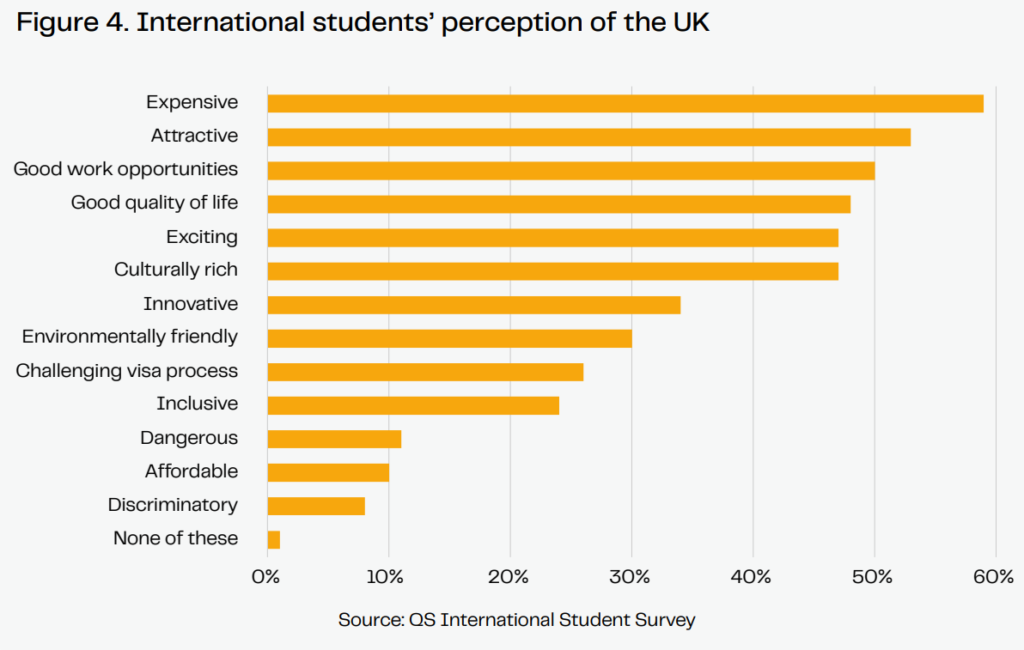
This is why we think the conversation around international recruitment increasingly needs to move from quality to value.
That doesn’t mean competing on price. It means being much clearer about what students receive for their investment – from teaching and student experience to employability, industry connections and ultimately career outcomes.
And QS suggests those outcomes are becoming more important. Since 2022, the importance of good graduate employment opportunities and building professional networks has increased. The ability to obtain a visa after graduating has risen by six percentage points as a factor in destination choice.
Employability therefore can’t just sit within the careers section of a university website. It’s increasingly part of the recruitment proposition itself.
More choice is making conversion harder
Students aren’t just assessing value more carefully – they’re also shopping around.
Half of prospective international students surveyed by QS are considering five or more universities, while 10% are considering more than ten.
At the same time, their expectations around communication are increasing. Fewer students consider three days an acceptable wait for a personal response, while the proportion expecting responses and application outcomes within 24 hours keeps rising.
That makes the conversion experience increasingly important.
When a student enquires, universities aren’t simply trying to persuade them to study in the UK. They could be competing against five or ten other institutions – potentially across several different countries.
Speed, personalisation and a clear reason to choose you can all make a difference.
And we’re seeing this play out in the current recruitment cycle. Despite international applications being significantly ahead earlier in the year, international acceptances have grown much more slowly.
There is still opportunity too. Two weeks into Clearing, 48,615 unplaced international applicants who had opted in to UCAS communications remained available to engage, demonstrating that a sizeable international audience was still actively in the market.
The way students research is changing
Official university websites remain the most important information source for UK-bound international students, followed by online search and rankings.
But social media is moving in the opposite direction to many traditional sources, increasing in importance by eight percentage points since 2022 – the largest increase recorded by QS. More than half of UK-bound students now use Instagram as part of their university research.
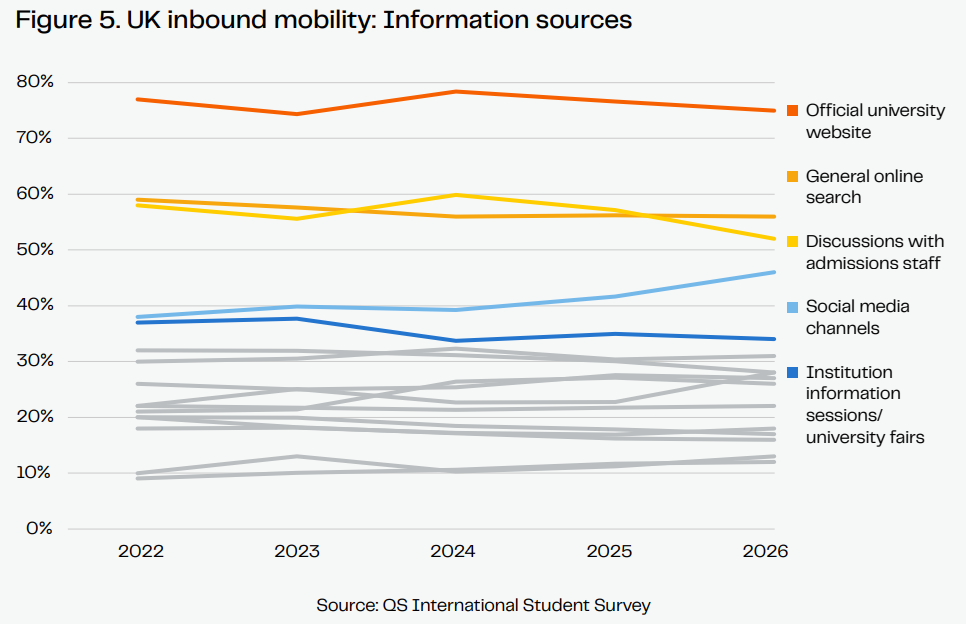
Alongside this, we’re also seeing AI play a growing role in how students research and compare their options.
This year’s Clearing activity has provided further evidence that students aren’t necessarily following the traditional search → university website → enquiry journey. AI tools, social media, search, rankings, agents and university websites increasingly overlap as students research and validate their choices.
That doesn’t make the university website less important. If anything, it may increasingly become the place students go to verify what they’ve already discovered elsewhere.
For universities, visibility is only part of the challenge. The story students find across all of those different touchpoints needs to be consistent and convincing.
Where is future growth coming from?
QS expects India and China to remain the UK’s two largest international source markets through to 2030, but forecasts quite different trajectories. India is forecast to grow by around 5.5% annually, while China is expected to remain broadly flat.
Interestingly, the 2026 undergraduate picture so far isn’t following that pattern.
Two weeks after Results Day, overall international acceptances through UCAS were 4% ahead of 2025. China continued to stand out at around 15% ahead year-on-year, while India was only slightly ahead.
It’s an interesting contrast with the longer-term forecast, and a reminder that individual markets can shift quickly. QS also identifies future growth opportunities across markets including Pakistan, Nepal and parts of Africa and Southeast Asia.
For us, the opportunity is in understanding what is happening now alongside where longer-term growth is expected to come from – and how that differs by institution, market and subject.
Our view
The positive headline from QS matters: international demand is there. But what we’re hearing from our clients – and seeing in the data – is that conversion is increasingly the challenge.
For us, there are two clear areas to focus on: targeting the markets where there is genuine demand, and making the conversion journey work harder.
We help our clients analyse where prospective students are dropping out of the application journey and develop nurture strategies to keep them engaged. That means delivering the right messages at the right time – whether that’s reassurance around employability, visa administration, safety or value – alongside clear calls to action that make it quick and easy to ask questions, get answers and continue their application.
Alongside this, understanding which markets, subjects and audiences are showing genuine demand means recruitment investment can be focused where there is the greatest opportunity.
Want to understand what these shifts mean for your international recruitment strategy? Get in touch with the Hunterlodge team mailto:nick.friend@hunterlodge.co.uk