
A new study commissioned by the Department for Education and carried out by KPMG has put some numbers behind a challenge universities have been talking about for years: what it actually costs to teach an undergraduate student.
Based on 2023/24 data, the research puts the average full economic cost of delivering a full-time first degree at an English university at £12,317 per student, per year.
But the more interesting finding is just how much that changes depending on what a student chooses to study.
Medicine, Dentistry and Veterinary Sciences are the most expensive subjects in the study, at an average £19,986 per student each year. Physical Sciences follow at £16,466, while Law comes in at £9,475.
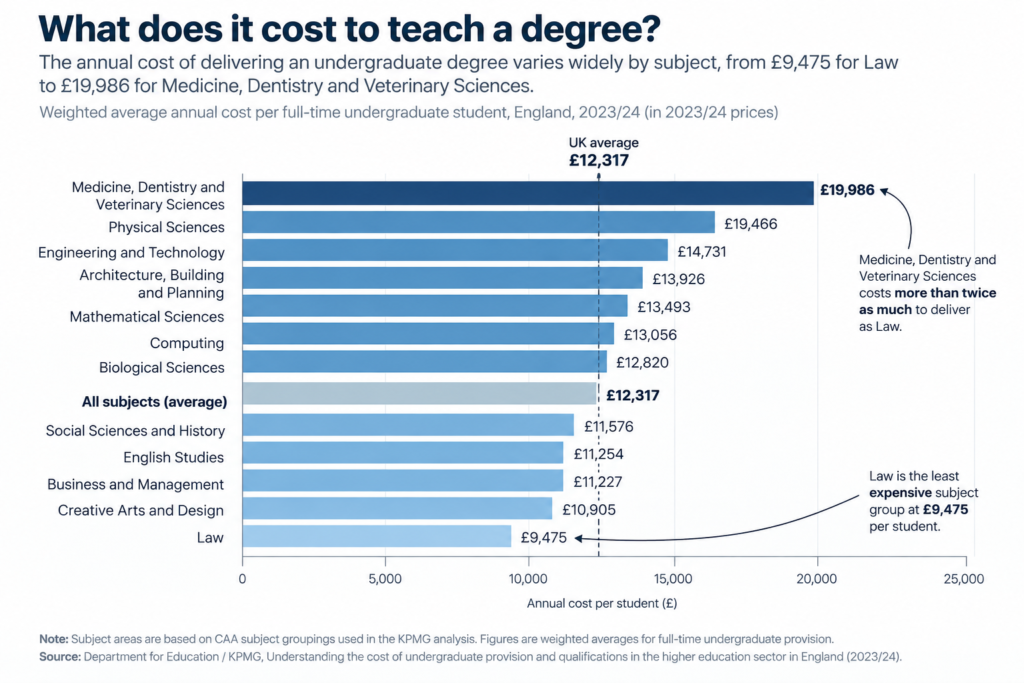
There are good reasons for the difference. Practical and technical courses require specialist staff, laboratories, studios, workshops and expensive equipment. Some also need lower student-to-staff ratios or have requirements set by professional bodies. Classroom-based subjects can generally operate with larger groups and less specialist infrastructure.
Universities have been absorbing rising costs
There is another interesting story in the numbers.
Since the previous study, using 2016/17 data, costs across different subject groups have risen by between 11% and 31%. Over the same period, RPIX inflation increased by 41.2%.
Staff costs increased by 14%, compared with a 46% increase in non-pay costs and 40% for estates. KPMG suggests this indicates universities have been managing costs in line with the income available and absorbing some of the inflationary pressure themselves.
And not all of the £12,317 is spent directly on teaching.
Around 64% of the average cost is classed as student-facing. Course delivery accounts for 25% of total costs, while corporate services – including IT, finance, HR and regulatory functions – account for 17%, estates another 15%, and marketing and admissions around 5%.
A rethink of the flat-fee model??
The research comes as the debate around university funding is once again gathering pace.
As reported in Times Higher Education, Libby Hackett, chief executive of the Russell Group, has called for a rethink of the current tuition fee model, questioning whether students should contribute the same amount regardless of the course or university they attend and describing the current system as “not fit for purpose”.
The KPMG research itself doesn’t recommend changing tuition fees and explicitly states that funding decisions are for the government.
But the findings inevitably raise a question: if courses cost dramatically different amounts to provide, should they always have the same price?
And what happens if universities themselves are eventually able to charge different amounts?
What could this mean for student recruitment?
For universities, variable pricing would add another dimension to an already complicated student decision.
Students are weighing course content, location, employability, experience, and living costs alongside a university’s reputation. If the price of a degree also begins to differ significantly by subject or university, demonstrating value becomes even more important.
A higher fee would potentially need a much clearer explanation of what a student receives in return – from facilities and contact time to industry links, placements, student support and graduate outcomes.
It could affect positioning too. Two universities recruiting for the same subject at different price points would need to be much clearer about what differentiates their offer.
None of this means variable fees are inevitable. There are significant questions around access, affordability and whether the additional costs of strategically important but expensive subjects should be met by students, universities or government.
But the research makes one thing very clear: while tuition fees may look relatively uniform to students, the economics behind delivering their degrees are anything but.
Our view
Whatever happens next with the funding model, the direction is clear: universities are under growing pressure to demonstrate value to prospective students.
If fees eventually become more differentiated, that conversation becomes even more important. Universities will need to show not simply what a degree costs, but what students can expect in return.
Get in touch with the Hunterlodge team mailto:nick.friend@hunterlodge.co.uk